

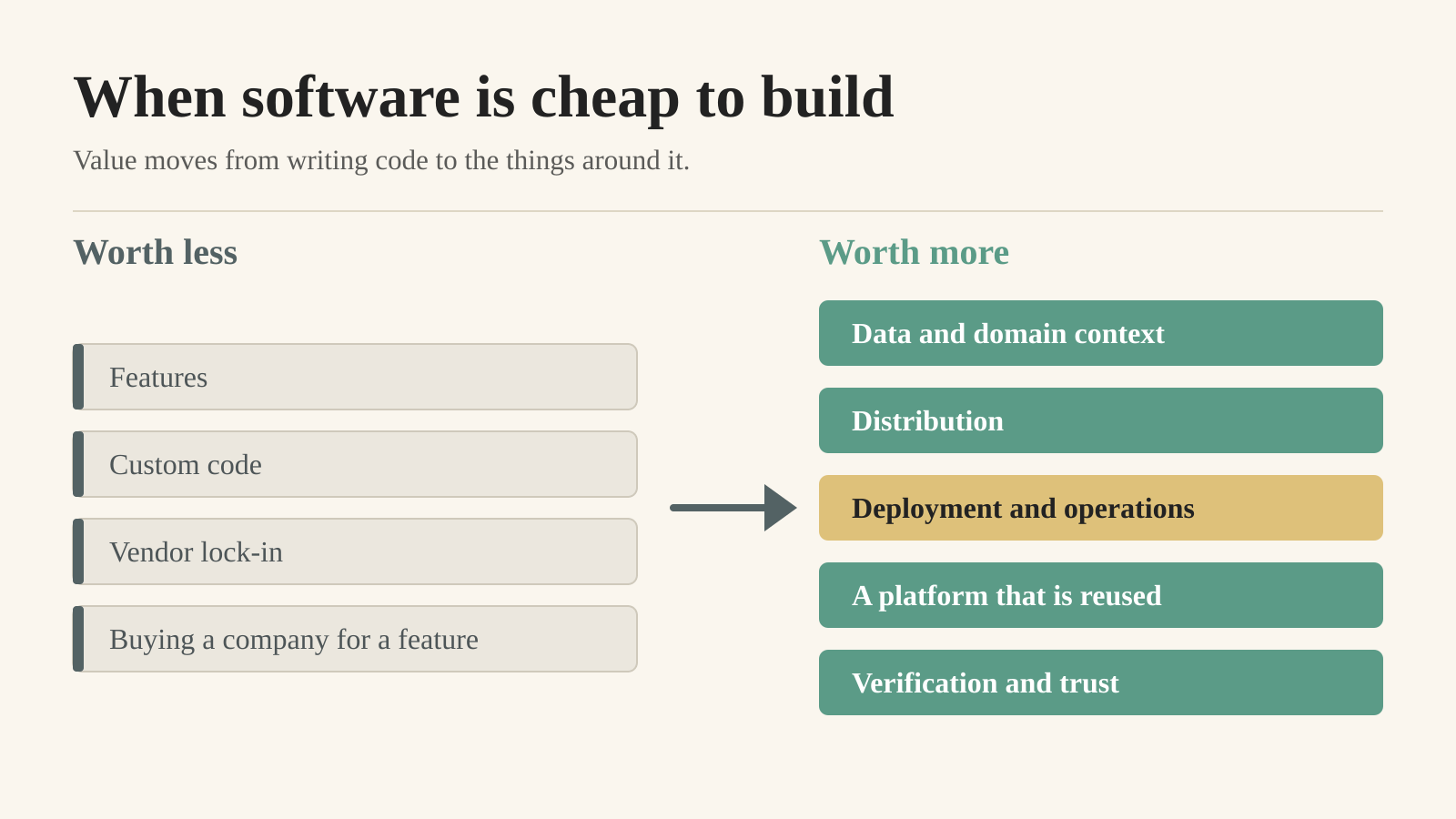
When complex software gets cheap to build, customers have more choices about what to build themselves and what to pay someone else to run. That changes the economics of the software industry, regardless of whether model vendors or app vendors win.
1. Features lose pricing power.
Incumbents can bundle more, startups can close feature gaps faster, and customers can build the missing workflow themselves. When anyone can build a feature quickly, code alone stops being a lasting advantage. Value moves toward unique data and domain context, and toward the distribution a vendor already has. Incumbents have the edge when the workflow lives inside their product. Startups have a better shot when it crosses several products. Pricing shifts too. If agents do more of the work and fewer people run each workflow, per-seat pricing shrinks, and vendors move to pricing by usage or by outcome.
2. Build vs. buy splits in two.
A customer can build its own procurement app and still pay a vendor to secure the data, enforce approvals, and keep the system running. Building custom software in house is easier than ever. Maintaining it is not, and many in-house builds turn into an operational burden. Systems of record can retain that role even if users spend their time in a different interface.
3. Switching costs fall.
If rewriting software is cheap, then migrating off a vendor is cheap too. Lock-in has been a big part of why incumbents keep customers, and that protection gets weaker. Bun’s rewrite from Zig to Rust is one example of a large codebase moving to a new language. Customers can build more, and they can also leave more easily.
4. Software and services converge.
Deployment, training, and ongoing operations become a bigger part of the sale. Software vendors take on more implementation work, while services firms can build more of what they used to integrate. A customer that runs its own custom code also takes on its security and compliance work, and many will pay a vendor to monitor and govern that code. Palantir is one example of this model: a shared platform underneath work built for each customer.
5. Margins depend on what the vendor can reuse.
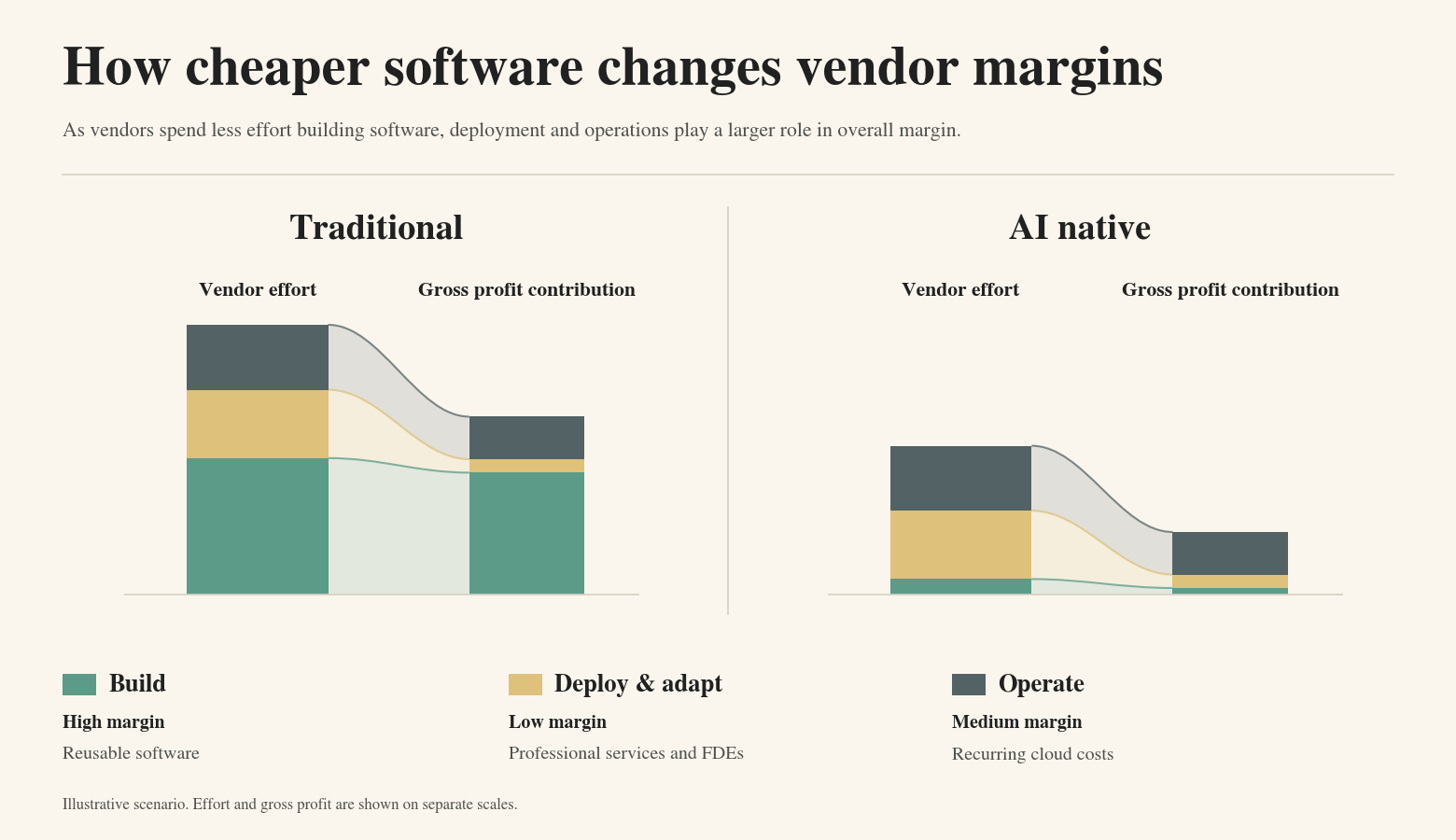
The first figure separates where vendors spend their effort from where they earn gross profit. In the traditional model, the vendor invests in building software it can sell repeatedly at high gross margins. In the AI-native scenario, the vendor spends much less effort building, and customers have more options for getting the same functionality. If that puts pressure on what vendors can charge for the software itself, more of the business may shift toward deployment and operations.
Deployment and adaptation tend to have lower margins when they require professional services and forward-deployed engineers. Running the software brings recurring cloud costs. The overall gross margin depends on how much revenue comes from each activity and what it costs to deliver. The figure illustrates one possible shift in that mix.
If each deployment makes the next one cheaper and existing customers can add workflows with little extra labor, the business can earn software-like margins. If each customer needs a dedicated team indefinitely, the economics look more like services.
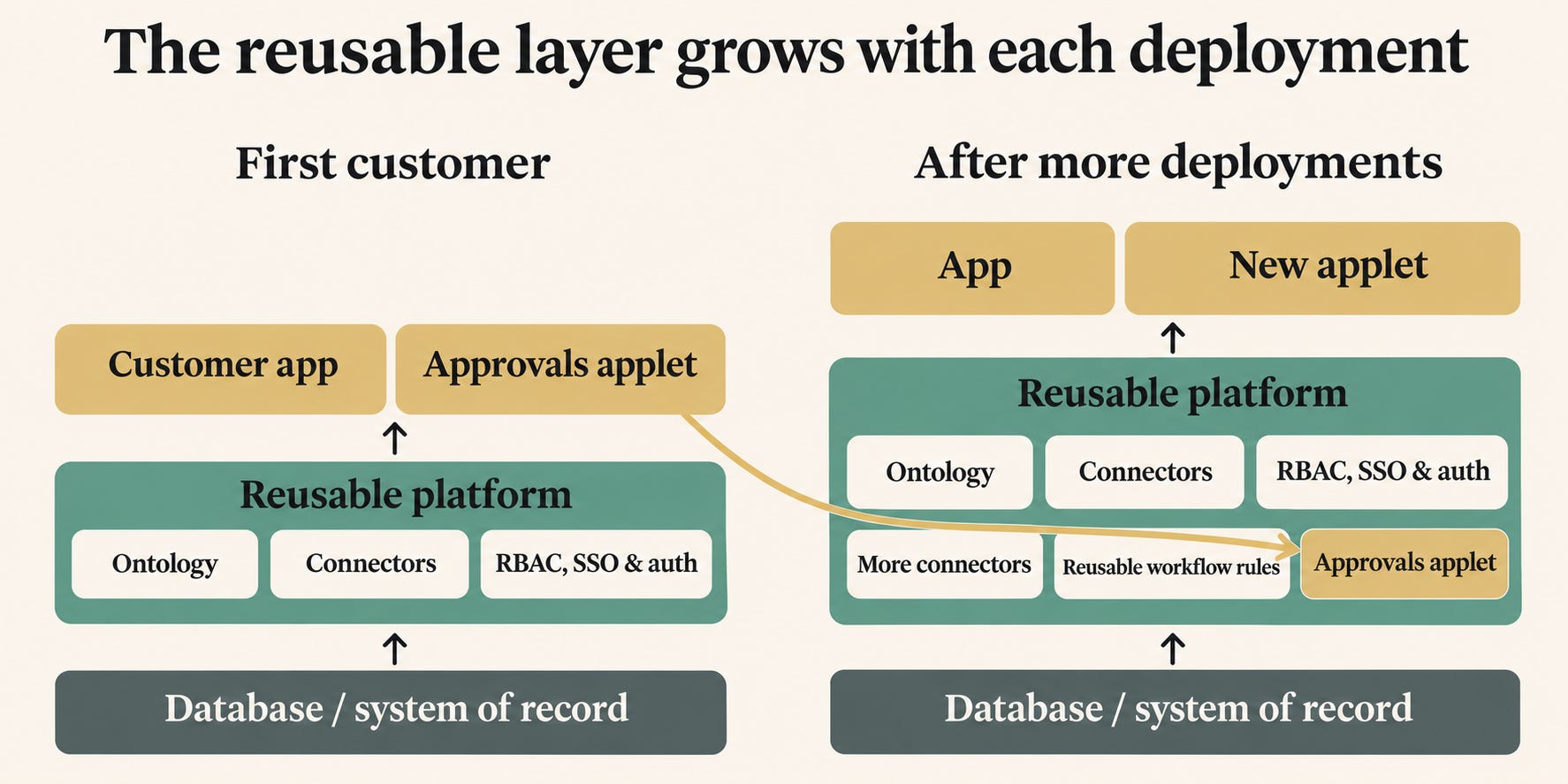
The second figure shows what reuse can look like. A database or system of record sits at the bottom. The middle layer holds the ontology, connectors, and access controls such as role-based permissions and single sign-on. Customer apps and applets sit above it.
Suppose the first customer needs a custom approvals applet. If that workflow comes up again, the vendor can turn the applet into a shared component. Future customers can start with it and configure their own policies. Over time, more connectors, rules, and applets can move into the platform, reducing the amount of custom work needed for the next deployment.
6. Verification becomes the bottleneck.
When code is nearly free to write, the scarce work is checking it. That means testing, code review, security and trust in the software supply chain. The amount of code grows faster than anyone’s ability to vet it. Value moves to the tools and vendors that can show software is correct and safe to run.
7. M&A shifts toward assets that take time to build.
Buying a company for a feature becomes harder to justify. Buying its distribution, customer relationships, or established role in a critical workflow may become more attractive.
Open question: bundling
Cheap code makes it easier for an incumbent to absorb features. It also makes it easier for customers to connect specialist products. Which effect wins could determine whether we end up with fewer software vendors or many more.