

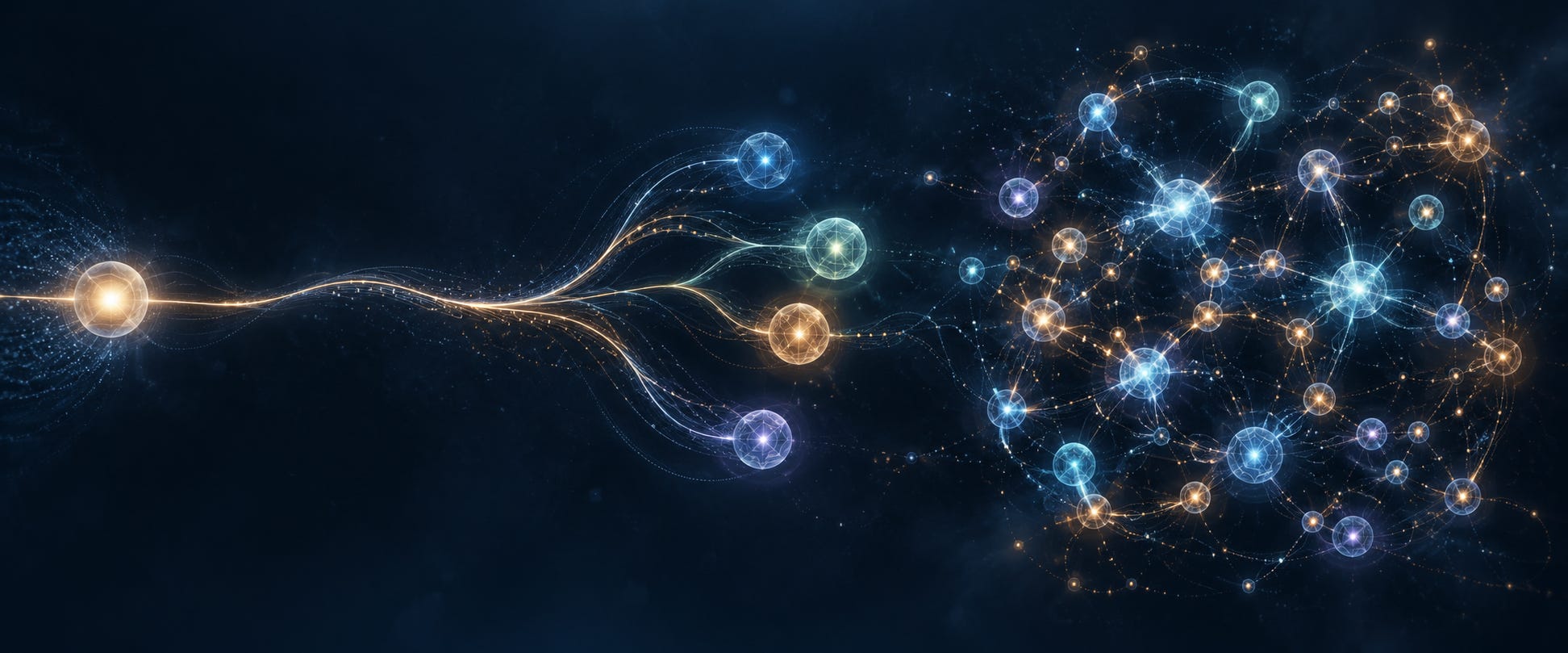
From a single reasoning path to an adaptive network of agents.
A human born a thousand years ago had roughly the same biological hardware we do. Yet humanity’s capabilities have expanded almost beyond recognition. We can build semiconductor fabs, sequence genomes, coordinate global supply chains, and land machines on other planets.
No individual can do any of those things alone. Those capabilities live in the network: language, specialization, institutions, tools, shared memory, and the ability to coordinate across teams and generations. Human intelligence scaled not only by making individuals smarter, but by linking many minds into what researchers call a collective brain.
Biology offers the same lesson in other forms. Ant colonies, bee swarms, flocks, and schools can navigate, allocate work, find resources, and survive failures without any single member understanding the whole problem. The intelligence is partly in the organism and partly in the organization.
That does not make swarm intelligence a scaling law in the precise mathematical sense. But it does establish something important: in biological intelligence, capability can grow dramatically through coordination even when the intelligence of each participant does not.
AI may be approaching the same transition. Models are no longer just answering questions. Increasingly, they are deciding how to organize the work needed to produce an answer.
The industry’s recent focus has been test-time compute: give a model more time and tokens to reason, let it explore several possible answers, and use a verifier to choose among them. This has produced meaningful gains without retraining the underlying model.
But there is another way to spend inference compute. Instead of asking one model to think longer, ask it to assemble a swarm.
Anthropic’s dynamic workflows make this concrete. Claude can write a program that creates subagents, divides work into phases, retries failures, and combines the results. A managed run can use as many as 64 concurrent threads and start up to 1,000 agents over its lifetime.
The obvious story is that we can run more agents. The more interesting story is that the model is beginning to design the organization through which it reasons.
From more thinking to better organization
Imagine asking an AI system to investigate a new market.
A conventional model might work through the problem sequentially. A test-time scaling system might produce several independent analyses and select the strongest one. A multi-agent system could instead create specialists: one studies the technology, another interviews the available data, a third looks for disconfirming evidence, and a fourth reconciles disagreements.
The same amount of compute can produce very different results depending on how those agents are connected. Do they work independently or share partial findings? Is there a central planner? Can one agent challenge another? Who decides that the evidence is sufficient? Can the system add a specialist when it encounters an unexpected problem?
These questions define the system’s topology: the number of agents, their roles, their communication paths, and the rules by which the organization changes.
That topology may become a scaling variable in its own right. The next capability gain may come not from a larger model or a longer chain of thought, but from a better-designed population of models.
Why this starts to look like swarm intelligence
Swarm intelligence is often described with examples from ants, bees, fish, and birds. The interesting feature is not simply that there are many participants. It is that useful group behavior emerges from local interactions, environmental feedback, and relatively simple individual rules.
A recent Nature Communications review highlights the qualities that make biological and robotic collectives powerful: decentralized control, scalability, flexibility, and resilience to the failure of individual members.
Those ideas map surprisingly well to the problems facing AI agents.
Diversity: agents need genuinely different hypotheses, tools, or perspectives. A hundred near-identical answers are parallelism, not collective intelligence.
Specialization: roles should emerge from the demands of the problem rather than being fixed entirely in advance.
Local communication: agents should exchange information with the peers whose work affects them, rather than route every observation through one central coordinator.
Environmental memory: a shared repository, filesystem, or world state can let agents coordinate indirectly—similar to the way biological systems leave signals in their environment.
Adaptive topology: add, connect, isolate, or retire agents as the task changes.
Recent work is beginning to turn the swarm analogy into measurable engineering results.
Google Research evaluated 260 agent configurations across six benchmarks and found that coordination improved performance by 80.8% on a parallelizable financial-reasoning task, but degraded performance by 39% to 70% on sequential planning tasks. Their conclusion was not that more agents are always better. It was that the architecture has to match the structure of the problem.
Cohere’s October 2026 work on coding-agent teams reached a similar conclusion. Well-organized teams improved results by as much as roughly 10 percentage points, but often cost three to seven times more than a solo agent. The most efficient configuration did not distribute every stage of the job. It used a strong lead and cheaper workers concentrated on the bottleneck—planning—coming within 1.4 points of an all-frontier-model team at 70% lower cost.
Other researchers are redesigning the coordination layer itself. Meta and Harvard’s ScaleMAS lets asynchronous agents publish, search, and build on linked messages in a shared datastore. It continued to improve on several benchmarks as the group grew, scaled to 128 agents, and remained resilient when agents failed. The s3 system went further by training agents to decide when to work alone, when to share, and what to read. With matched budgets, its learned swarms solved more than 25 times as many coordination problems as the strongest baseline and reduced duplicated exploration.
A November 2026 paper adds another twist: one enormous swarm may not be the best unit. Across long-horizon tasks, multiple small teams of ten agents outperformed isolated agents on 10 of 12 tasks and beat a single team of 100 everywhere the researchers tested that comparison. The best architecture may look less like one giant crowd and more like a portfolio of small, diverse teams.
Taken together, these results suggest a more precise version of the thesis. Agent count is not the scaling law. Productive coordination is. Diversity, topology, shared memory, task decomposition, and the ability to learn when to communicate determine whether a swarm compounds intelligence or merely compounds noise.
Today’s agent teams are proto-swarms
We should be careful not to call every multi-agent workflow a swarm.
Anthropic’s dynamic workflows are adaptive in an important sense: the model can write the orchestration program for the problem at hand. But the program still acts as a central coordinator. Subagents receive assigned prompts, return results to the workflow, and generally do not reorganize themselves through local interaction.
That is closer to a dynamically generated company than a flock of birds. It can be highly useful, but its intelligence remains concentrated in the planner and the aggregation logic.
There is another limitation. If every agent uses the same underlying model, training data, and reasoning habits, their errors may be highly correlated. A thousand agents can simply reproduce the same blind spot at greater cost. Diversity has to be designed or learned; it does not appear automatically because the thread count increased.
Coordination itself also consumes compute. Agents can duplicate work, overwrite shared state, amplify incorrect claims, or spend more tokens debating than solving. Beyond some point, the cost of managing the organization can exceed the value of adding another member.
The relevant metric is therefore not the number of agents. It is the improvement in outcome per additional unit of coordinated inference.
A new infrastructure layer
If agent topology becomes part of the capability stack, it creates a set of infrastructure problems that look different from today’s prompt frameworks.
Orchestration runtimes will need to allocate models, tools, and budgets dynamically rather than execute fixed graphs.
Shared-state systems will need to support concurrent work while preserving provenance and preventing agents from silently corrupting one another’s results.
Identity and reputation systems will need to track which agent produced a claim, how reliable it has been, and what authority it should have.
Evaluation and observability will need to explain not only the final answer, but how the organization formed, where disagreements occurred, and which paths consumed the budget.
Security systems will need to contain compromised or manipulative agents before errors propagate across the population.
These could become important markets because they address the scarce part of the system. Model calls are becoming easier to obtain. Reliable coordination is not.
The next scaling law may be swarm intelligence
Multi-agent reinforcement learning asks how a population can improve through repeated interaction during training. Dynamic agent systems raise the complementary question at inference time: can a model organize a temporary population that is more capable than any member working alone?
Today’s systems are still early. We now have credible evidence that coordinated teams can outperform solo agents and use inference compute more effectively. But we do not yet have a universal curve. The gains depend on the task, the models, the diversity of the group, and the cost of coordination.
Still, the direction is important. We have spent years scaling the intelligence inside a model. The next frontier may be scaling the intelligence between models.
The defining question will not be how many agents a system can launch. It will be whether those agents can form the right organization for the problem—and whether that organization can adapt when the problem changes.
That is the point at which more inference compute stops looking like brute force and starts looking like a digital collective brain.
Sources and further reading
Cohere: Scaling agent teams—reach the frontier at 30% of the cost
ScaleMAS: Scaling Multi-Agent Intelligence with Substrate-Centric Coordination
Parallel agent teams: Test-Time Compute Scales Better with Parallel Agent Teams
Group Coordination Catalyzes Individual and Cultural Intelligence
Anthropic Cookbook: Orchestrate subagents at scale with dynamic workflows
Nature Communications: Collective intelligence in animals and robots
The correlated-errors limitation is the deep one here: agents sharing one frozen model reproduce the same blind spot at any thread count, and the Google result (coordination up 80.8% on parallelizable work, down 39% to 70% on sequential planning) shows topology amplifies what the base system already does well. Biology gets its swarm gains partly because each bee also learns from experience between flights; deployed models carry nothing between sessions. That difference decides whether swarm scaling compounds capability or merely compounds parallelism: https://seldondance.substack.com/p/automated-intelligence-is-not-artificial #AIAgents
Guru, "agent count is not the scaling law, productive coordination is" is the right correction, and the list you give (diversity, specialization, local communication, adaptive topology) reads like a spec for a healthy network of minds. One thing I'd add to the picture is who the nodes belong to. A swarm run by a single orchestrator inside one company is still a centralized system, just with more parts. A swarm where individuals own their nodes, with different models in different niches, gets the resilience you describe and keeps the people in it. That's what we're sketching as POND, a Human-Machine Intelligence (HMI) ecosystem: https://www.pond.is/p/pond-a-human-machine-intelligence