

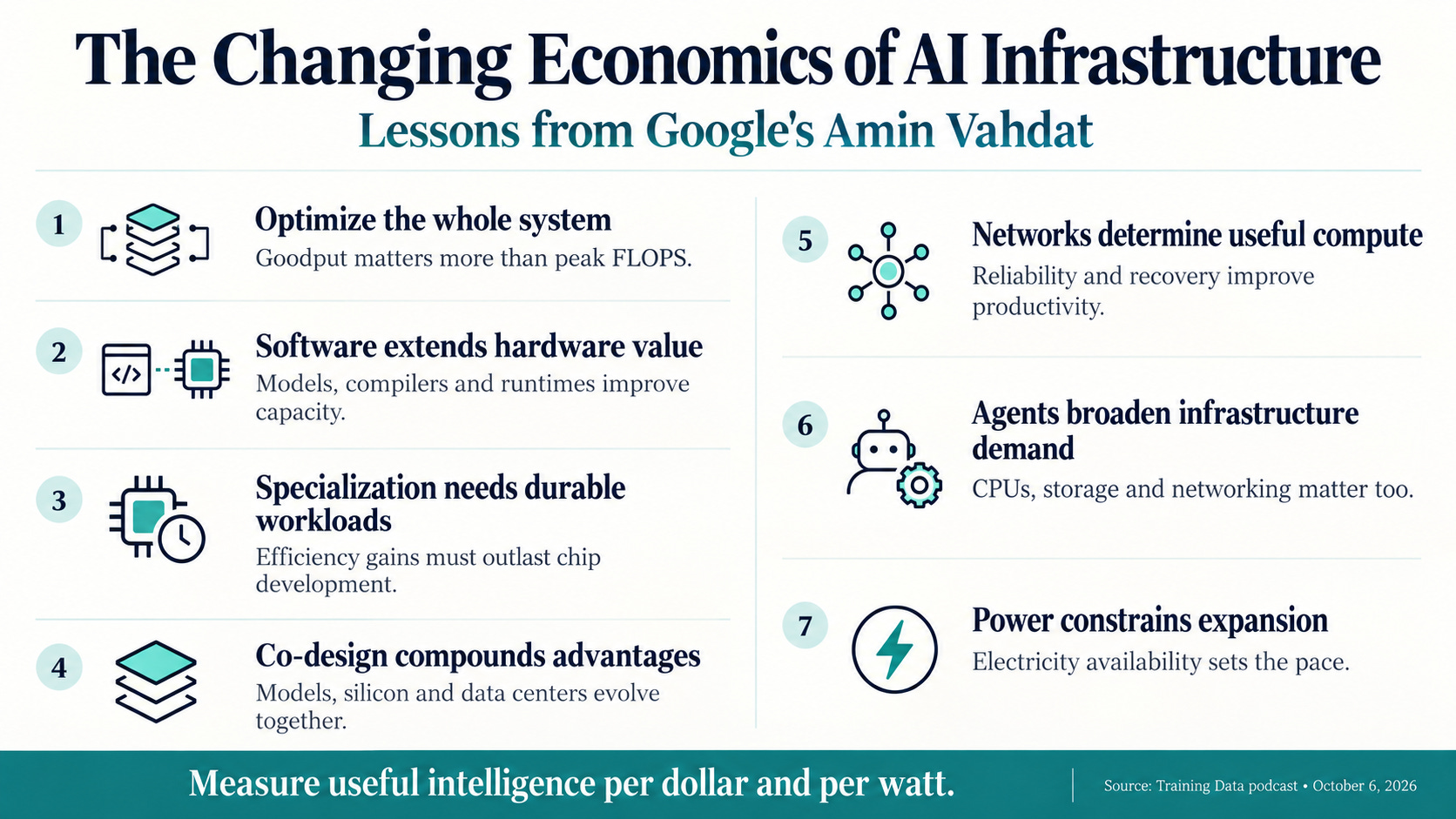
I recently listened to an excellent Training Data podcast featuring Amin Vahdat, Google’s Chief Technologist for AI Infrastructure.
Amin oversees much of the infrastructure underlying Google’s AI efforts, spanning custom silicon, networking, data centers, and the systems needed to train and serve frontier models.
What I found particularly interesting was how much of the conversation focused on the economics of the entire system rather than the performance of individual chips.
Here are the ideas that stood out to me.
1. AI infrastructure is becoming a systems engineering problem
For decades, data centers were designed to accommodate different generations of servers, storage, and networking equipment. Buildings typically had useful lives of 25–30 years, so flexibility was important.
AI is changing that approach.
A conventional storage rack might consume 10–40 kilowatts. Modern AI accelerator racks can consume hundreds of kilowatts, and the industry is already contemplating megawatt-scale racks.
These requirements are sufficiently different that designing a building for every possible future configuration becomes expensive and inefficient.
Google is increasingly co-designing its data centers with the hardware they will house, including power distribution, cooling, and networking.
The same principle extends to compute performance.
Amin argues that peak FLOPS is an incomplete measure of AI infrastructure productivity. He prefers a metric Google calls goodput: the useful computation a system actually delivers after accounting for failures, recovery, and other inefficiencies.
Consider a training job spanning 100,000 accelerators. At that scale, something can fail multiple times a day, potentially multiple times an hour. Each interruption may require detecting the problem, recovering from a checkpoint, and repeating some computation.
A system with higher theoretical performance can therefore deliver less useful work than one with better reliability and recovery.
This makes scheduling, observability, checkpointing, and fault recovery part of the performance equation, not simply operational concerns.
The relevant unit of optimization is increasingly the entire AI cluster, not the individual accelerator.
2. Software improvements are as important as new hardware
Google has set an ambitious internal objective of roughly doubling its effective token-generation capacity every six months.
That does not mean doubling the number of chips.
Amin explains that substantial improvements come from model architectures, compilers, runtimes, and serving software.
Better models can deliver more intelligence for the same computation. Better infrastructure software can extract more useful work from existing hardware.
In fact, Amin suggests that improvements in models and software have often contributed more to intelligence per watt than hardware advances alone.
This is an important distinction.
The industry pays enormous attention to each new generation of GPUs and TPUs. But software improvements can compound across multiple generations of hardware, including chips that have already been deployed.
Google has TPUs that remain fully utilized seven or eight years after deployment, despite generally depreciating hardware over approximately six years.
Not every workload needs the latest accelerator. Older chips can remain economically productive, particularly when software improvements extend their usefulness.
This suggests that increasing the productivity of installed compute capacity could be as important as adding new capacity.
3. Specialized silicon requires predicting the future
One of my favorite parts of the conversation was Amin’s discussion of the tradeoff between specialization and flexibility.
Specialized hardware can deliver substantial improvements in performance and power efficiency. But the more specialized the hardware, the less flexible it becomes.
The challenge is predicting whether the workload being optimized will remain important over the chip’s useful life.
Google began developing TPUs in 2013, initially targeting inference. Since then, the architecture has evolved through multiple generations of AI workloads, including transformers and large-scale training.
Interestingly, Amin notes that the fundamental computational primitives underlying TPUs have remained relatively stable.
Much of AI computation still relies on a common set of linear algebra operations, even as model architectures have evolved.
Google is now taking specialization further with two eighth-generation TPU variants:
TPU 8i, optimized for inference.
TPU 8t, optimized for training.
The economics depend heavily on the expected workload mix.
If inference represents only 2–5% of future demand, building a separate inference architecture may not make sense. If it represents 30–60%, the economics become much more compelling.
Both chips retain the ability to run training and inference workloads, preserving some flexibility.
This illustrates an important principle for semiconductor startups.
The question isn’t simply whether custom hardware can accelerate a particular workload. It’s whether that workload will be sufficiently large and durable several years from now, when the chip is actually deployed.
In AI, where algorithms evolve much faster than semiconductor development cycles, that’s a difficult prediction.
4. Hardware-software co-design may be Google’s biggest advantage
Amin’s description of how Google’s infrastructure teams collaborate with DeepMind was particularly revealing.
Google’s chip architects and AI researchers work together on hardware and model design. Sometimes that involves modifying a chip approaching tape-out because a model optimization would benefit significantly from additional hardware support.
In other cases, the model or software is adapted to the hardware.
These decisions involve tradeoffs. A hardware change might improve performance substantially but delay tape-out. The teams need to evaluate the benefit across the entire system.
Google can make these tradeoffs because it controls much of the stack: models, compilers, chips, networking, and data centers.
Most companies operate across only one or two of these layers.
The benefit of vertical integration isn’t simply that Google builds its own chips. It’s that optimizations can compound across multiple layers.
A model architecture change might reduce memory requirements. A compiler improvement might increase accelerator utilization. A networking improvement might reduce training interruptions.
Each improvement makes the others more valuable.
There are tradeoffs, of course. General-purpose infrastructure provides portability, flexibility, and a broader software ecosystem.
But as AI workloads become larger and more expensive, the economic benefits of optimizing the complete system become increasingly meaningful.
5. Networking and reliability are becoming central to AI performance
Large AI clusters are effectively distributed computers spanning thousands or tens of thousands of accelerators.
The network connecting those accelerators is therefore part of the compute architecture itself.
Amin discussed Google’s use of optical circuit switching, which allows physical network connections to be reconfigured by changing the paths taken by light.
One important application is failure recovery.
When a rack fails, Google can use optical switching to reconnect workloads to spare capacity rather than permanently reducing the cluster’s available compute.
These connections can be reconfigured on millisecond timescales.
At the scale of frontier training, these capabilities can materially improve goodput.
This is another example of why measuring individual chip performance misses much of what determines actual system productivity.
Network topology, bandwidth, latency, congestion management, and fault recovery all affect how much useful computation a cluster delivers.
6. Agentic AI will reshape infrastructure demand
Much of today’s AI infrastructure discussion revolves around GPUs and TPUs.
But Amin expects agentic AI to change the composition of infrastructure demand.
A conventional inference request might involve generating a response and returning it to the user.
A long-running agent may execute thousands of steps, invoke tools, run code, retrieve information, maintain state, and interact with external systems.
This creates demand for infrastructure beyond accelerators.
CPUs become important for tool execution and orchestration. Storage becomes important for maintaining state and intermediate results. Networking becomes more important as agents interact with distributed services.
In other words, agentic workloads could increase demand for the broader data center infrastructure stack.
This is particularly interesting because the infrastructure requirements of agents may be quite different from those of model training.
The next wave of AI infrastructure investment may therefore be distributed across more categories than just accelerators.
7. Power is the ultimate constraint
Despite the enormous innovation in chips, models, and software, Amin repeatedly returns to power as the fundamental constraint.
AI compute capacity can increase through more efficient hardware and software, but physical expansion ultimately requires electricity.
And obtaining electricity at the required scale is difficult.
Generation capacity, transmission infrastructure, substations, and grid connections can take years to develop.
Google generally prefers working with utilities rather than independently operating gigawatt-scale power generation.
This makes power availability, time to energization, and infrastructure efficiency increasingly important economic considerations.
It also explains why Amin emphasizes goodput per watt.
The objective isn’t simply to maximize theoretical compute capacity. It’s to maximize the useful work delivered for each watt consumed.
As the industry contemplates megawatt-scale racks and increasingly large AI clusters, this becomes a critical metric.
The conversation also touched on more speculative possibilities, including orbital data centers. Whether those become economically viable remains uncertain, but their consideration reflects the scale of the industry’s power and infrastructure challenges.
What this means for AI infrastructure
Three broader observations stood out to me.
First, the unit of competition is shifting from components to systems. The economics of an AI cluster depend on the interaction between models, software, silicon, networking, reliability, and power. Optimizing any one component in isolation is increasingly insufficient.
Second, optimization may be as important as expansion. The industry is investing enormous amounts of capital in new compute capacity, but improving the productivity of existing infrastructure can generate substantial economic value. Software that improves utilization, reliability, and inference efficiency deserves as much attention as the next generation of hardware.
Third, specialization creates opportunities, but predicting workload durability is essential. Custom silicon can deliver meaningful performance and efficiency gains. The difficult part is identifying workloads that will remain sufficiently large and stable over a multiyear hardware development and deployment cycle.
For me, the biggest takeaway is that AI infrastructure should increasingly be evaluated by the useful intelligence it delivers per dollar and per watt, rather than simply by accelerator counts or peak FLOPS.
That is a more complicated way to measure infrastructure performance, but it is much closer to the economics that will determine which architectures succeed.
Source: Training Data — Google’s AI Infrastructure Chief, Amin Vahdat, on the Physics & Economics of Frontier AI, October 6, 2026.