

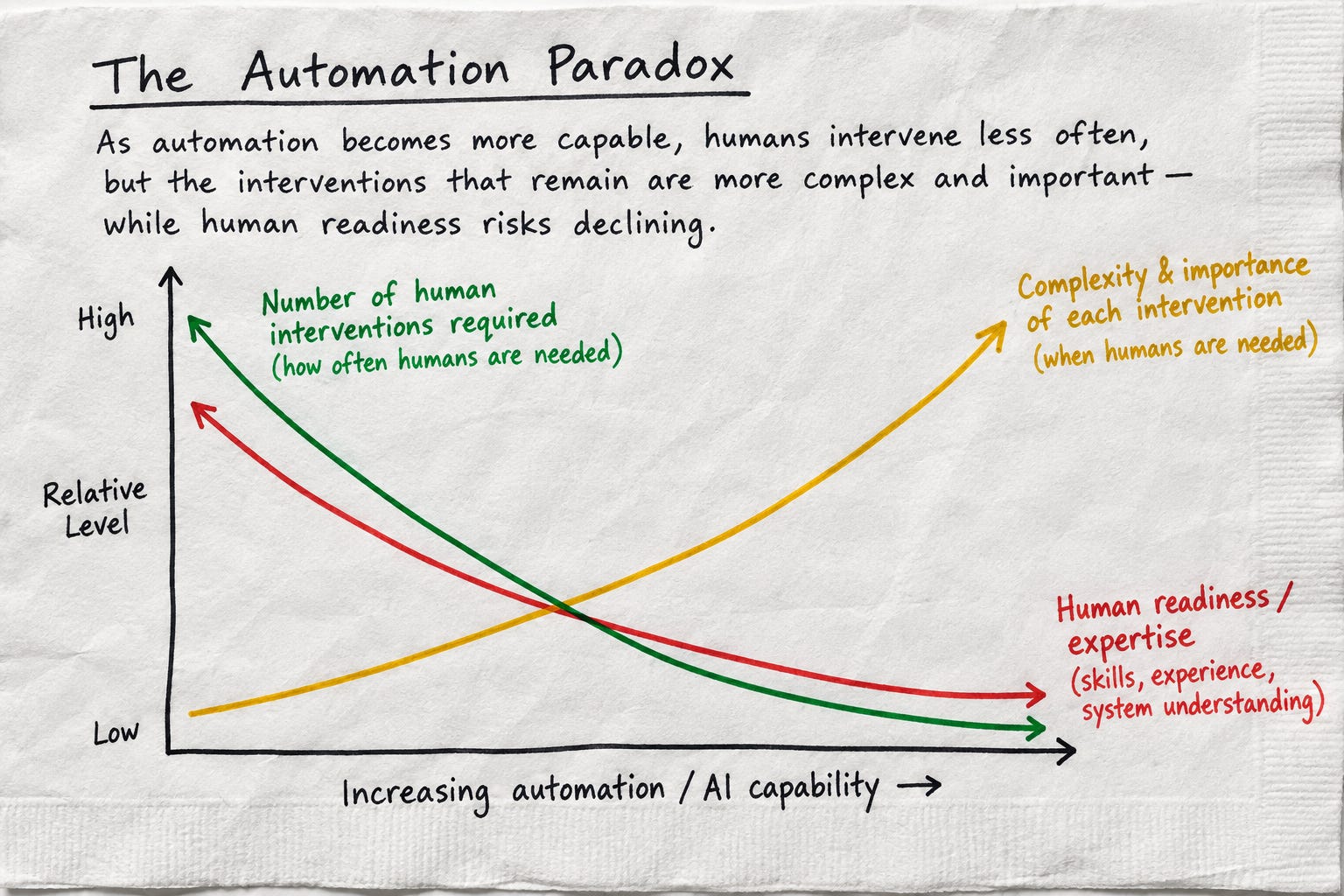
As automation gets better, humans have to intervene less.
That sounds like the whole point. But it creates an interesting paradox: the less frequently humans need to intervene, the more important their contribution becomes when they do.
This maps closely to what human-factors researcher Lisanne Bainbridge called the “ironies of automation” in 1983: as automation improves, the human is increasingly left responsible for abnormal conditions—precisely when judgment matters most.
Consider driving.
As a self-driving system gets better, it handles more of the routine situations: staying in a lane, maintaining distance, navigating intersections, changing lanes. Eventually the human may only need to take over once every thousand miles—or perhaps once every hundred thousand.
But think about what that intervention represents.
If the automated system has successfully handled millions of similar situations before, the situation that finally defeats it is unlikely to be routine. It is probably something unusual: construction arranged in a way the system hasn’t encountered, contradictory instructions from a police officer, debris in the road, or some strange combination of circumstances that falls outside its training distribution.
In other words, automation handles the normal cases and increasingly leaves humans with the weird ones.
This means human judgment doesn’t become less valuable as automation improves. It becomes more valuable.
But there is a catch.
Where does that judgment come from?
A good driver develops intuition from thousands of hours behind the wheel. You learn how cars behave, how other drivers behave, how roads work, and what to do when something unexpected happens.
If the car drives itself 99.99% of the time, we stop accumulating those experiences. Existing skills decay, and new drivers may never develop them in the first place.
So just as automation makes human judgment most valuable, it may also systematically destroy the experience required to exercise that judgment.
We’ve seen this before
Commercial aviation has been dealing with versions of this problem for decades. Modern aircraft are highly automated, leaving pilots to supervise systems that work correctly the vast majority of the time. But when pilots are needed, it is often because something unusual has happened.
One response has been simulation. Pilots don’t have to wait for an engine failure, unusual weather event, or automation failure in the real world to learn how to handle one. Simulators deliberately expose them to rare situations so they can build and maintain skills that normal operations no longer exercise.
That may be an important model for the AI era.
As AI agents increasingly write software, operate infrastructure, investigate security incidents, analyze financial information, or perform other knowledge work, humans may find themselves in the same position as pilots: supervising systems that usually work and being called upon primarily when they don’t.
At first, automation is a tool used by an expert.
Eventually, the automation becomes the expert and the human becomes the exception handler.
The danger is that we design systems around the assumption that a human can always step in—while gradually creating humans who no longer understand the system well enough to do so.
Simulators for knowledge workers
Perhaps the next category isn’t simply better observability or human-in-the-loop tooling. It is something closer to simulators for knowledge workers.
These systems could continually expose humans to edge cases, failures and counterfactuals. They could keep our mental models of increasingly autonomous systems current, identify where our expertise is decaying, and test whether we’re actually capable of taking over when the machine needs us.
A software engineer supervising coding agents might periodically encounter deliberately broken architectures or subtle security vulnerabilities. A security analyst supervising autonomous SOC agents might face synthetic attacks specifically designed to defeat those agents.
The goal wouldn’t be to keep humans artificially involved in routine work. It would be to keep them capable of handling the non-routine work that remains.
The challenge of automation, therefore, isn’t simply getting humans out of the loop.
It’s figuring out how to keep humans capable while they’re mostly out of the loop.
Automation creates the skill-decay problem. But AI might also give us the first technology capable of continuously generating the experiences humans need to prevent that decay.
Perhaps the same technology taking humans out of the loop can also prepare them for the moments when they most need to get back in.
Hi Guru! The automation paradox is true. I think I would call this the apprenticeship problem. In professional services such as law, accounting, investing, and consulting, routine tasks include research, drafting, financial modeling, market research, and deal sourcing, which are usually used to build judgment. However, AI is automating the very tasks that have accumulated judgment over the years. I've written this automation paradox in my piece on the venture capitalist's trolley problem. I'd love to know your thoughts on the essay.
https://harshithviswanath.substack.com/p/the-venture-capitalists-trolley-problem
I see what paradox you're pointing at, and it's very very real. Apart from the ones you listed, AI in Legal is another one where the liability risk originating from this paradox is very high.
Guru, when AI hallucinates, it's already hard enough to track hallucinations. While you're pointing at resolution being more difficult because of this paradox, I would further add that even detection will become extremely difficult (in case of AI in legal for example).
For humans to intervene, we should be able to flag. the question is, is AI efficient enough to even flag the corner cases?