

I’ve been following AI for several years, and lately I’ve been revising my expectations more often.
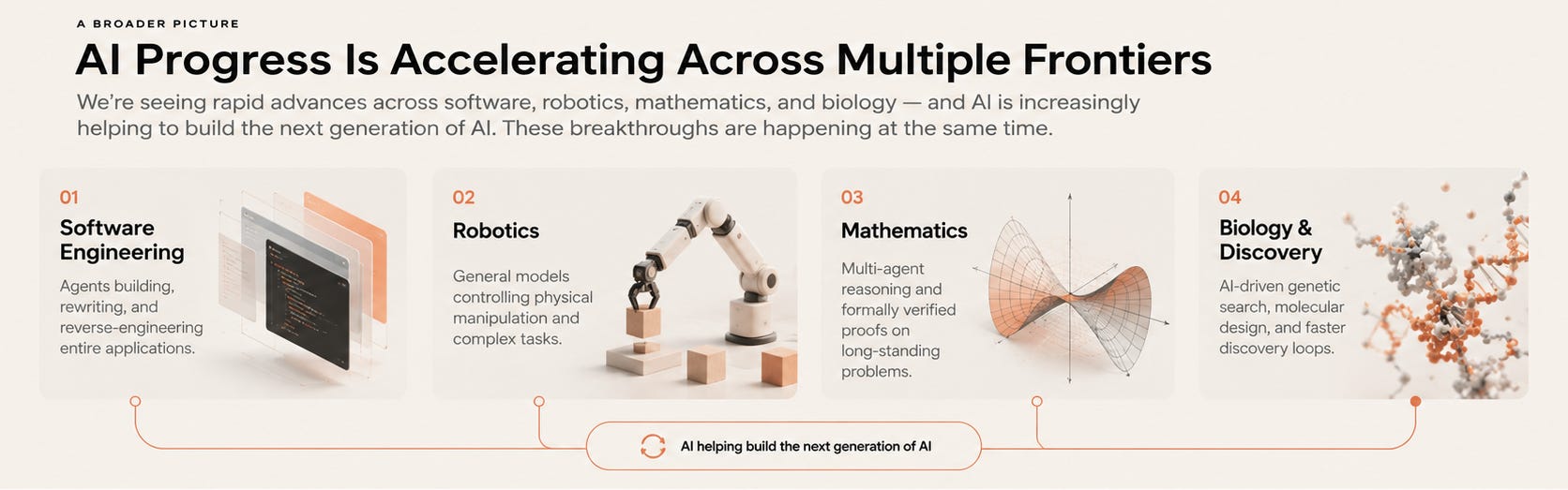
It’s hard to measure the pace from individual demos, but I’m seeing progress in several areas at once: software development, robotics, mathematics, and biology.
Many of these examples are still early. What interests me is how much work the systems are taking on, and what still needs human judgment or testing.
A few examples that caught my attention recently:
Coding agents are taking on larger projects
A developer recently used Claude to build clean-room implementations of major creative and productivity applications in Rust.
The developer reported millions of lines of code, tens of thousands of tests, and substantial functionality built over a few weeks.
These aren’t production-ready replacements for Adobe or Microsoft Office. There are significant gaps in compatibility, reliability, and functionality.
I’m interested in how much of an application these agents can now build and reason about, even with those limitations.
We’re also seeing agents inspect existing codebases, reverse-engineer software behavior, and perform large architectural rewrites.
As agents take on more implementation work, specifying requirements, reviewing code, and testing the result become a larger part of the developer’s job.
General-purpose AI models are starting to control robots
Robotics has traditionally required specialized models trained for specific physical tasks.
Recently, we’ve seen demonstrations of general-purpose AI models generating low-level robot actions, including manipulating objects and controlling robotic arms.
In one example, a model controlled a relatively inexpensive robotic arm to paint an image with physical brushes.
There are also reports of better results on manipulation benchmarks after replacing the underlying model.
There are still significant challenges around latency, reliability, feedback, and real-world generalization.
That suggests general-purpose models could handle more of the reasoning behind physical tasks, alongside specialized systems for perception, control, and execution.
If that holds up outside the lab, it would give these models more uses beyond knowledge work.
Using agents in scientific research
Researchers are using groups of AI agents to search biological sequence databases for potentially novel molecular systems.
In one reported experiment, hundreds of agents examined metagenomic data and identified an unusual arrangement of genetic elements that researchers subsequently investigated in the laboratory. (Primary source: Anthropic, https://www.anthropic.com/research/claude-discovers-novel-enzyme-system)
The biological function remains uncertain, and the novelty of the finding has been debated.
The workflow interests me: agents search large datasets, identify patterns, and suggest hypotheses for researchers to test in the lab.
We’re seeing a similar approach in drug discovery, where systems increasingly combine molecular prediction, generative design, and experimental feedback.
That could help researchers explore more hypotheses. The experiments still have to establish which ones are useful.
Mathematical reasoning and proof checking
Recent reports describe multi-agent AI systems tackling difficult mathematical problems, producing analytical constructions, and using formal proof systems such as Lean to check their work. (Primary source: OpenAI, https://openai.com/index/navier-stokes-solution/)
Other systems have reportedly made progress on open problems associated with Paul Erdős.
These claims deserve careful scrutiny. Formal verification, mathematical novelty, and resolving a famous open problem are not necessarily the same thing.
Combining mathematical exploration with machine-checkable proofs could help researchers find and check new results.
Genetic prediction and drug discovery
DeepMind’s AlphaGenome work and Isomorphic Labs’ drug discovery efforts offer other examples. (Primary sources: Google DeepMind, https://deepmind.google/blog/alphagenome-atlas-a-predictive-map-of-every-possible-dna-letter-change-in-the-human-genome/ ; Isomorphic Labs, https://www.isomorphiclabs.com/articles/the-isomorphic-labs-drug-design-engine-unlocks-a-new-frontier)
Foundation models are being used to predict the effects of genetic variations, model molecular interactions, and design candidate compounds against multiple biological objectives.
Meanwhile, AI-originated drug candidates are progressing through clinical development.
We should distinguish computational predictions from experimental validation, and clinical progress from demonstrated therapeutic success.
These tools could let researchers do more early screening computationally and choose which candidates to test in physical experiments.
How much time and cost that saves will depend on how well the predictions hold up.
What I’m watching
The common thread is that these systems are taking on more of the work within each field.
Software: Agents are moving from coding assistance toward implementing and modifying complete systems.
Robotics: General-purpose models are beginning to perform tasks that previously required specialized policies.
Mathematics: AI systems are exploring difficult problems and producing machine-checkable proofs.
Biology: Models and agents are increasingly involved in hypothesis generation, molecular design, and experimental prioritization.
I’m also watching how researchers use AI to develop the next generation of models.
Coding agents are contributing to research infrastructure, experiment implementation, evaluation, and other parts of model development.
Better coding tools could shorten parts of the research cycle and help teams run more experiments. That would be useful even without autonomous, recursive self-improvement.
Over the next two years
A successful demo doesn’t tell us how reliable or affordable a system will be in daily use. Those gaps matter in all of these examples.
Over the next year or two, I’ll be watching how much of this becomes practical: building applications from specifications, carrying out research with less supervision, and handling a wider range of physical tasks.
I expect progress to be uneven. My sense is that more of these capabilities will become useful, but the test is whether people can depend on them outside a demo.
The line I'd underline is the one about what still needs human judgment or testing. Capability gains are easy to see in demos. The rate at which people stop checking is harder to see and probably moves faster. Reliability gaps close slowly, while the habit of trusting the output forms in weeks.
I like that you point out the clean-room Rust rewrites are not production replacements for Adobe or Microsoft Office, and still count them as a signal. Millions of lines and tens of thousands of tests is a lot of work, but compatibility gaps are where such projects usually stall. What would you want to see before calling one of them usable?